
First-of-its-kind Singapore study shows AI social robots improve well-being across generations
Conducted from July 2024 to March 2026, the pilot study by AWWA and the Singapore University of Social Sciences (SUSS), in partnership with Temasek Foundation, provides one of the first cross-generational series of insights into how AI social robots can enhance care delivery in community settings.

Tan Lay Hui found LOVOT’s expressive and endearing presence drew her to it.
A new study has found that AI-powered social robots can significantly improve emotional well-being and engagement among seniors as well as children with high support needs. They also improve caregivers’ mental health. This study offers new evidence for how technology can complement human care in Singapore’s social service sector.
The pilot study conducted by AWWA and the Singapore University of Social Sciences (SUSS), in partnership with Temasek Foundation, is the first in Singapore to examine the impact of an AI social robot across both seniors and children with high support needs.
Associate Professor Kelvin Tan, gerontology programmes, SUSS, said: “We have studied social robots across care settings, and this 12-week cross-generational study is our most comprehensive to date. Conducted in real-world community care environments, the findings show that LOVOT’s affective design can sustain engagement among both seniors and children, while supporting caregivers’ well-being. This underscores the potential of human-centred technologies to improve care outcomes and quality of life.”
The longitudinal study was implemented across AWWA’s senior care and early intervention centres from July 2024 to March 2026. The study involved 171 participants, of which 105 were seniors.
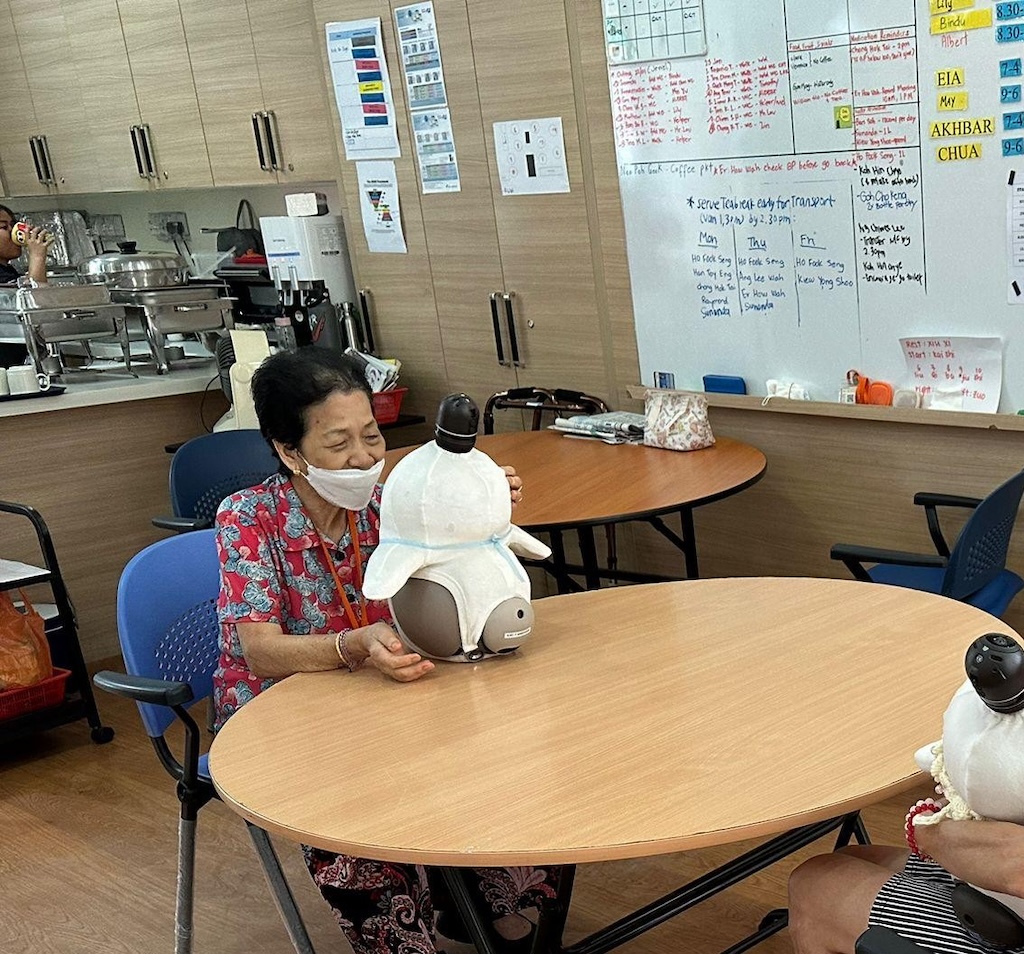
Mary Gan found LOVOT a source of both comfort and companionship.
LOVOT, the social companion robot used in the study, uses AI to respond to people in real-time through movement, sound and interactive behaviours. It creates a warm and engaging presence that supports attention, participation and emotional connection during structured and organic activities.
Findings showed significant improvements across both age groups. Among seniors, interactions with LOVOT were associated with improved quality of life, greater subjective happiness and technology acceptance. Participants across diverse backgrounds, including those living with dementia (who made up slightly more than half of the cohort), reported improved perceptions of their own health. Qualitative interviews revealed that LOVOT also provided meaningful companionship and emotional connection.
Also care professionals and caregivers across both groups reported that LOVOT helped reduce the need for repeated prompting and supervision, supported more independent engagement during activities, and eased caregiving demands. These findings suggest that when used intentionally within structured programmes, social robots can complement human-led interventions and contribute to a more responsive and supportive care environment.
Rather than replacing human interaction, the study found that LOVOT serves as a supportive tool. It helps to bridge communication gaps, sustain attention, and create moments of emotional connection, particularly for individuals who may face challenges in traditional engagement settings. For seniors, it works inclusively across age, gender, ethnicity, education level, mobility and cognitive status.
For 83-year-old Tan Lay Hui, it was LOVOT’s expressive and endearing presence that drew her to it. She enjoyed chatting to LOVOT, calling it over and watching it roam at AWWA’s Day Care Centre. Mary Gan, 80, also had a positive experience with LOVOT, finding it a source of both comfort and companionship.
Building on these findings, AWWA will continue working with partners to explore how technology-enabled solutions can be integrated across a wider range of care settings and client groups, which includes expanding the use of LOVOT across senior care.
0 Comments